

Diana Pardo Pedraza
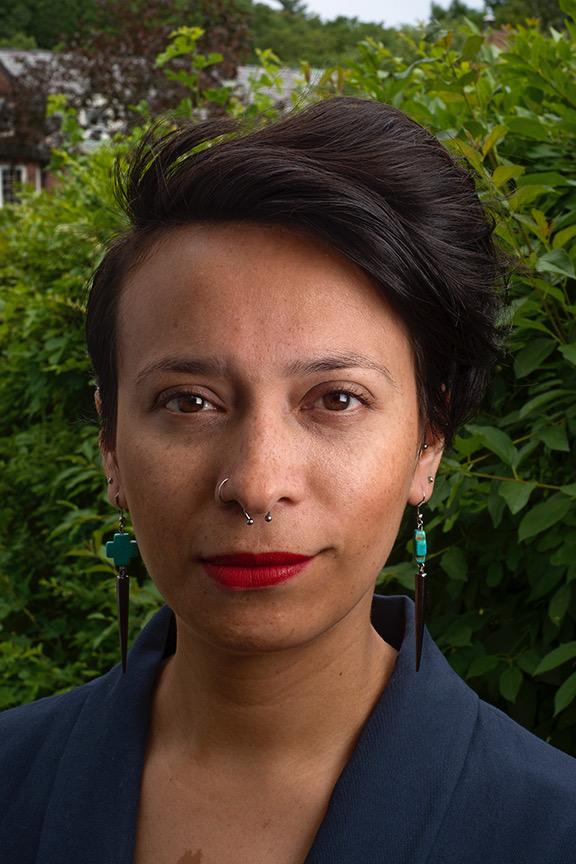
Diana Pardo Pedraza
Assistant Professor of Anthropology and International Affairs
Full-time Faculty
Department: Anthropology
Contact:
Office 302 Hortense Amsterdam House, 2110 G St. NW
Washington DC 20052
I'm an Assistant Professor of Anthropology and International Affairs. I received a Ph.D. from the University of California, Davis in Cultural Studies with a Designated Emphasis in Feminist Theory and Research. My ethnographic work, based in rural Colombia, considers (de)militarized landscapes, post-conflict economics, environmental politics, and multispecies relations of aid and care.
Anthropology of Violence & Peace; Environmental Anthropology; Feminist Science & Technology Studies; Critical Humanitarian and Security Studies; Political Ecology; Colombia & Latin American Studies.
Explosive legacies of warfare. Practices & politics of humanitarian demining. (Post)conflict & development in Latin America and Colombia. Multispecies ethnography.
My current and future research examines how armed conflict, humanitarian aid, and peacebuilding reshape landscapes, political relations, and everyday life, and how human and nonhuman communities participate in these transformations.
My first book, Fields of Suspicion: Landmines and the Making of Peace in Rural Colombia, is currently in production with Duke University Press and will be out in March 2027. Drawing on over twenty-four months of ethnographic fieldwork, Fields of Suspicion examines how explosive contamination, armed conflict, state neglect, and extractive projects produce environments saturated with anxiety and doubt. These affective landscapes endure as mine clearance and the promise of peace pledge safety and renewal—and, in many ways, precisely because of them. Rather than presenting demining as a purely technical or humanitarian activity, Fields of Suspicion shows how it is entangled with broader social projects of governance, territorial control, and economic progress. Yet the book is equally attentive to the fragile and unfinished labor of partial recuperation. Despite continuing suspicion, Army deminers, rebel soldiers, government officials, humanitarian workers, and campesinos (small farmers) strove to rebuild trust among themselves and with the territories they inhabit, testing the possibilities of peace.
My current research project, and next book project, tentatively titled Tails without Borders: Mine Detection Dogs and the Breeding of Global Security, is a multi-sited ethnographic study of how dogs become living technologies and social agents within global humanitarian and security regimes. The project investigates the biological, technical, and institutional trajectories through which detection dogs are bred, trained, circulated, and eventually retired. Tails without Borders follows these dogs’ trajectories from kennels and training grounds in Bosnia and Herzegovina to minefields in Cambodia and Colombia, and to retirement homes in Norway and the U.S.
Ph.D., 2019, Cultural Studies with Designated Emphasis in Feminist Theory and Research, University of California, Davis, USA.
M.A., 2010, Cultural Studies, Universidad de los Andes, Colombia
B.A., 2009, History, Universidad de los Andes, Colombia
Anthropology of Latin America. ANTH 3702
Anthropology of Environmental Politics. ANTH 3991/6591
Anthropology of Science and Technology. ANTH 2502
Social Study of Science and Technology. ANTH 6504
Book
In production “Fields of Suspicion: Landmines and the Making of Peace in Rural Colombia.” Duke University Press. Coming out in March 2027.
Journal articles (*indicates peer-reviewed)
Forthcoming Alternativas infernales: entre campos minados, el temor de la (re)ocupación y la sospecha residual. Revista Colombiana de Antropología. Coming out in January 2027.*
2026 Grounding Specifics: Rats and Dogs in Landmine Detection. Co-authored with Darcie DeAngelo. War & Society. LINK*
2025 Time and the remains of war: Retazos of morgues and minefields in Colombia. Ethnography 0 (0): Co-authored with Julia Morales Fontanilla. LINK*
2024 Ordinary Warfare and Militarized Landscapes. A Syllabus. Critical Ethnic Studies Journal. 8 (2). Fall 2023. LINK
2023 Sensory Co-laboring: Mine Detection Dogs and Handlers in Humanitarian Demining in Colombia. Environmental Humanities 15 (3): 30–51. LINK*
2023 Ethical Disconcertment and the Politics of Troublemaking: Land Mines, Humanitarian Demining and Ecologies of Trouble in Rural Colombia. American Ethnologist 50 (3): 462–73. LINK*
2023 Explosiveness: Territories of War and Technoscientific Practices in Colombia. The Journal of Latin American and Caribbean Anthropology. 28 (3): 239-250. Co-authored with Julia Morales Fontanilla. LINK*
2023 Response to commentaries to explosiveness: Territories of war and technoscientific practice in Colombia. The Journal of Latin American and Caribbean Anthropology. 28 (4): 360-361. Co-authored with Julia Morales Fontanilla. LINK
2023 “Introduction to The Domestication of War.” Catalyst: Feminism, Theory, Technoscience 9 (1). Co-authored with Xan Chacko, Jennifer Terry, and Astrida Neimanis. LINK
2020 Artefacto Explosivo Improvisado: Landmines and Rebel Expertise in Colombian Warfare. Tapuya: Latin American Science, Technology and Society 3 (1): 472–92. LINK*
Book Chapters
2023 Q de Quiebrapatas. In Belicopedia. Edited by Daniel Ruiz Serna and Diana Ojeda. Bogotá, Colombia. Universidad de los Andes. LINK
2017 The Amputated Body: Ghostly and Literal Presence. In Territories of Conflict: Traversing Colombia through Cultural Studies. Edited by Andrea Fanta Castro, Alejandro Herrero-Olaizola, Chloe Rutter-Jensen, New York: University of Rochester Press. LINK*
Book Reviews
2023 War as an Environment: Domesticity, Bitterness, and Multispecies Attachments to Life. Current Anthropology 64 (3): 352–53. LINK
2022 Legacies of War: Violence, Ecologies, and Kin by Kimberly Theidon. Anthropological Quarterly 95 (4): 497–504. LINK
Special Issues
2023 Co-editor (with Xan Chacko, Jennifer Terry, and Astrida Neimanis) of The Domestication of War.” Catalyst: Feminism, Theory, Technoscience 9 (1). LINK*
Online articles and publications (editor-reviewed)
2023 Making Peace Possible Amidst Minefields. Hot Spots, Fieldsights, July. LINK
2022 Landscapes of Suspicion: Minefields and Cleared-Lands in Rural Colombia. Theorizing the Contemporary, Fieldsights, January. LINK
2020 On Landmines and Suspicion: How (not) to Walk Explosive Fields. Environment & Planning D: Society & Space, Forum. LINK
2020 Mine Detection Dog ‘Unit’: More Than Humans in the Humanitarian World.” Platypus: The CLASTAC Blog. LINK